Understanding Prostate Cancer
What prostate cancer is, how it is found and staged, and how the grade and stage shape the treatment options ahead.
A guide for patients: what prostate cancer is, how it is found and staged, and the main treatment options for cancer that is confined to the prostate as well as cancer that has spread. Understanding the language early makes the decisions ahead far easier.
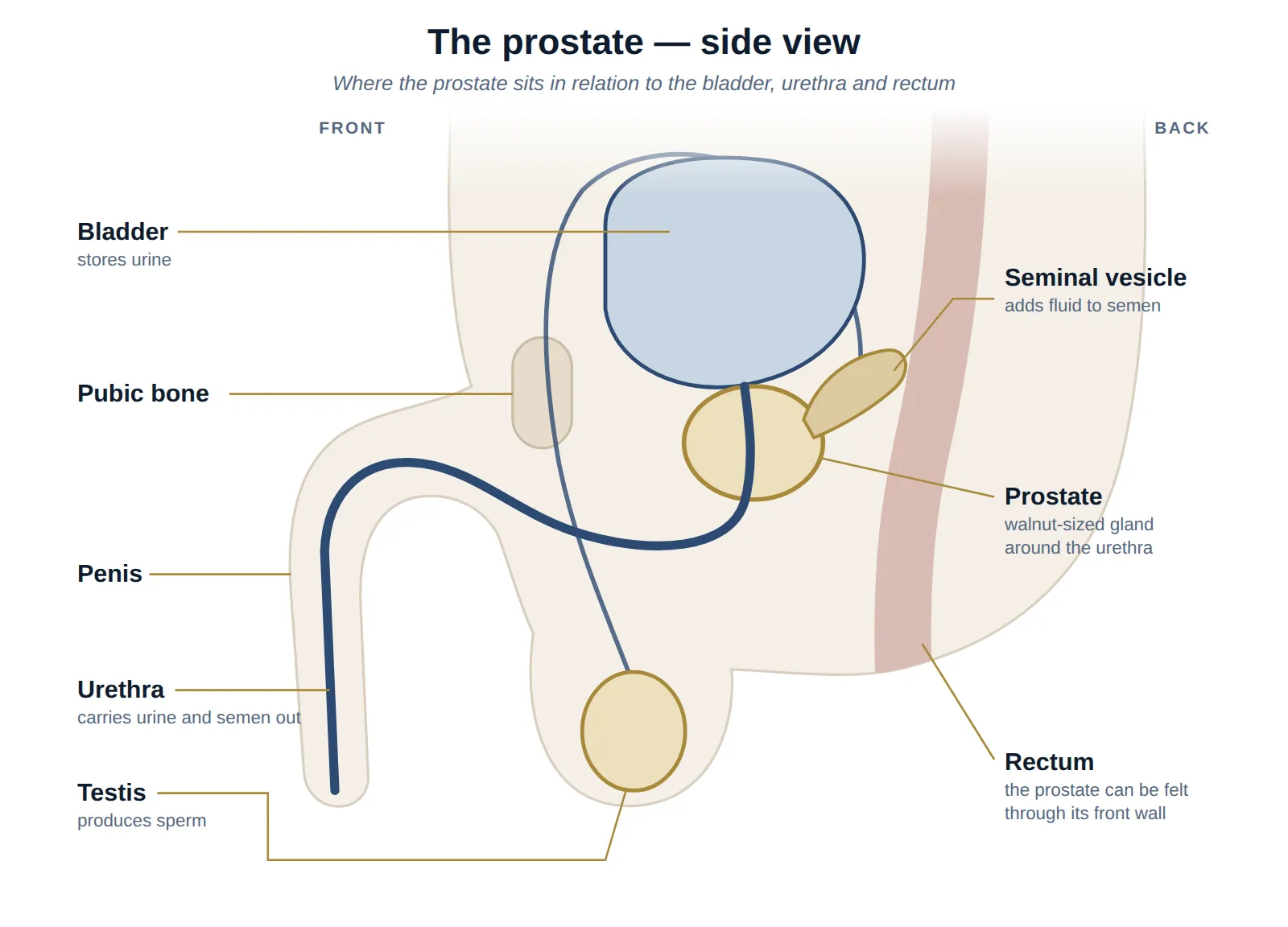
The prostate is a small gland, about the size of a walnut, that sits below the bladder and surrounds the top of the urethra — the tube that carries urine out of the body. It produces some of the fluid that makes up semen. Because of where it sits, both the prostate itself and its treatment can affect urinary and sexual function.
Who it affects and why
Prostate cancer is one of the most common cancers in men. The risk rises with age, and is higher in men with a family history of prostate, breast or ovarian cancer, and in men of African or Afro-Caribbean descent. Most prostate cancers grow slowly, and many men with the disease will never have symptoms from it — but a minority are more aggressive and need prompt treatment. Telling these apart is central to everything that follows.
How it is usually found
Prostate cancer is often suspected before it causes any symptoms, usually after a blood test called PSA (prostate-specific antigen) is found to be raised, or after a change is felt during an examination of the prostate. Early prostate cancer rarely causes symptoms; when symptoms do occur they may include a weaker urinary stream, needing to pass urine more often, or blood in the urine or semen — although these are far more commonly caused by a benign (non-cancerous) enlarged prostate.
Making the diagnosis
If prostate cancer is suspected, the modern pathway usually involves an MRI scan of the prostate before any biopsy. The MRI helps identify suspicious areas and allows the biopsy to be targeted precisely, while sparing some men a biopsy altogether. A biopsy — taking small tissue samples from the prostate — is what confirms the diagnosis and shows how aggressive the cancer is.
Grade and stage: the two things that shape your plan
Two pieces of information drive almost every decision.
Grade — how aggressive the cells look. A pathologist examines the biopsy and assigns a Gleason score (6–10), which is now also expressed as a simpler Grade Group from 1 to 5. A lower grade means the cells look close to normal and tend to grow slowly; a higher grade means they look more abnormal and behave more aggressively.
| Grade Group | Gleason score | What it means |
|---|---|---|
| 1 | 6 or less | Low grade — cells look close to normal; slow-growing |
| 2 | 7 (3+4) | Mostly low-grade pattern |
| 3 | 7 (4+3) | Mostly higher-grade pattern |
| 4 | 8 | High grade |
| 5 | 9 or 10 | Highest grade — most aggressive |
Stage — how far it has spread. Staging describes whether the cancer is confined to the prostate, has extended just beyond it, or has spread to lymph nodes or elsewhere in the body (most commonly the bones). A PSMA-PET scan gives the most accurate picture of distant spread and is recommended depending on your cancer’s risk. Together, your PSA level, grade and stage place you in a risk category that guides treatment.
| Category | What it describes | In brief |
|---|---|---|
| T — Tumour | How far the cancer has grown within or beyond the prostate | T1: not felt or seen, found on biopsy T2: confined to the prostate T3a: grown through the prostate capsule T3b: grown into the seminal vesicles T4: grown into nearby structures |
| N — Nodes | Whether it has reached nearby lymph glands | N0: no nodes involved N1: nearby nodes involved |
| M — Metastasis | Whether it has spread to distant sites | M0: no distant spread M1: distant spread (e.g. bone, distant nodes, other organs) |
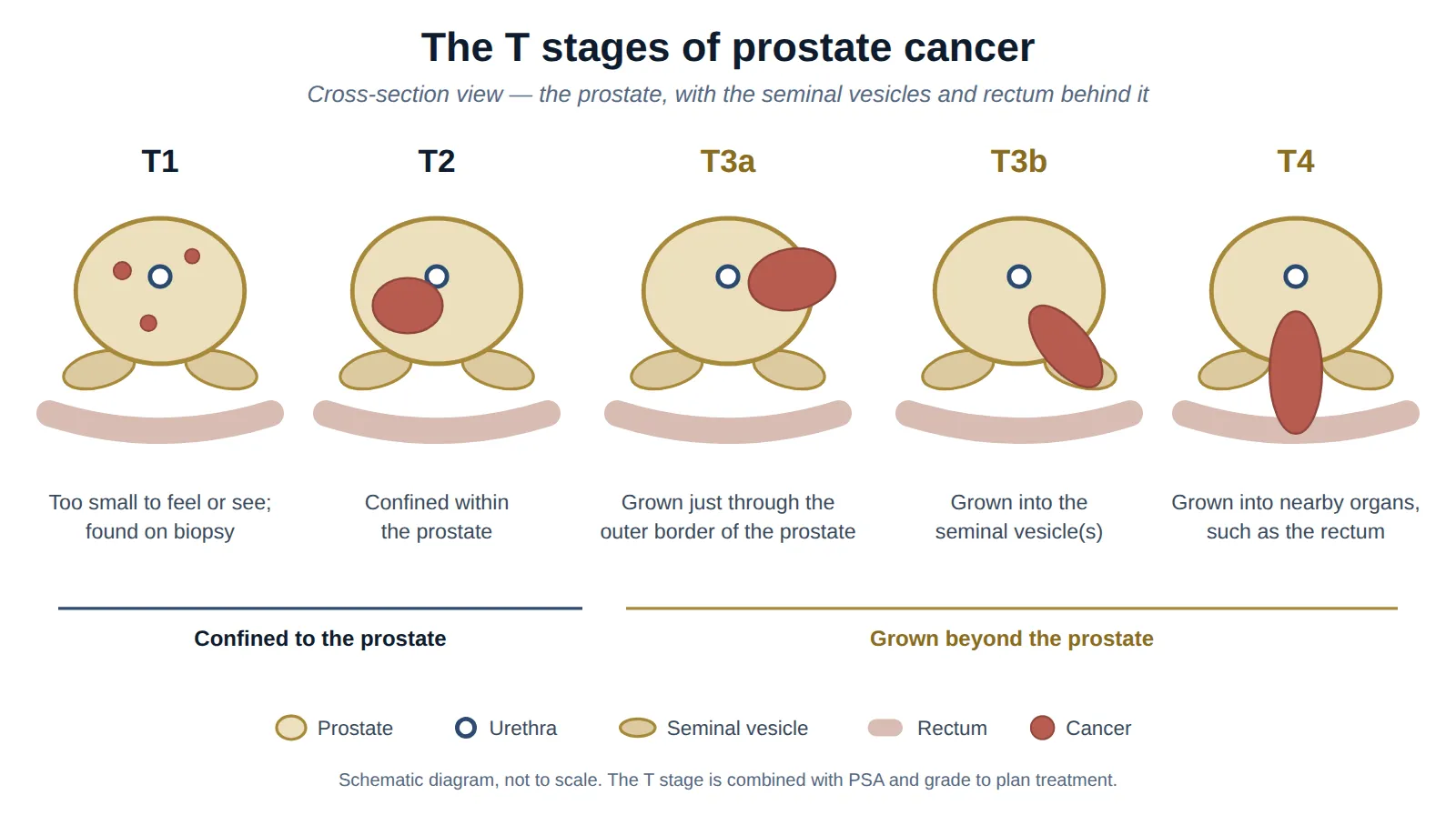
Your PSA level, Grade Group and T-stage are combined into a risk group. The European Association of Urology (EAU) classification is widely used; in its current form the intermediate-risk group is divided into favourable and unfavourable to guide treatment more precisely.
| Risk group | Typical features |
|---|---|
| Low | PSA under 10, Grade Group 1, and stage cT1–cT2a |
| Intermediate | PSA 10–20, or Grade Group 2–3, or stage cT2b — split into favourable and unfavourable depending on how many of these apply |
| High | PSA over 20, or Grade Group 4–5, or stage cT2c and above |
These cut-offs are a general guide; your team will interpret them alongside your MRI, the amount of cancer found, and your general health.
If your PSA is raised but no cancer has been found yet, see raised PSA: what it means and next steps.
Have a question about this condition?
Dr Tan consults at SJMC, Kuala Lumpur.