Understanding Testicular Cancer
An uncommon cancer, mainly affecting younger men — and one of the most treatable of all cancers, even when it has spread.
A guide for patients: what testicular cancer is, how it is found, the main types, how it is staged, and the blood tests (tumour markers) that play an important role throughout. Testicular cancer is uncommon, mainly affects younger men, and is one of the most treatable of all cancers — even when it has spread.
What it is and who it affects
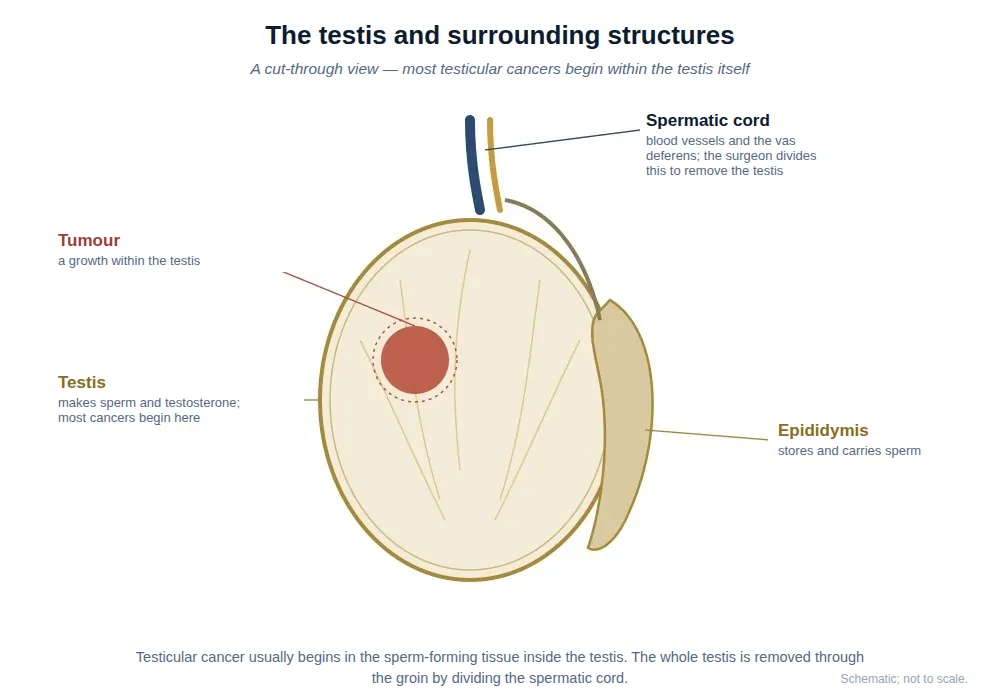
The testes (testicles) sit within the scrotum and produce sperm and the male hormone testosterone. Testicular cancer usually begins in the sperm-forming cells and is called a germ cell tumour. It is most common in men between their late teens and thirties. The main risk factors are having had an undescended testicle, a family history, or previous testicular cancer in the other testis. Most cases, however, occur in men with no obvious risk factor.
How it is found
The commonest sign is a painless lump or swelling in a testicle, or a change in its size or firmness. Occasionally there is a dull ache or heaviness. Any new testicular lump should be checked promptly. The first test is usually an ultrasound scan of the scrotum, which is quick and painless, followed by blood tests (tumour markers, below). If cancer is suspected, a CT scan is used to check whether it has spread.
The two main types
Germ cell tumours fall into two broad groups, and the distinction guides treatment. Seminoma tends to occur in slightly older men and generally grows more slowly. Non-seminoma (which includes several sub-types grouped together) tends to occur in younger men and can behave more aggressively. Some tumours contain a mixture of both; these are treated as non-seminoma. In older men (typically over 60), a different type of cancer — testicular lymphoma — becomes the most common. It is not a germ cell cancer, and its treatment is different from what is described here.
Tumour markers
Some testicular cancers release substances into the blood that can be measured. These tumour markers are useful in three ways: they support the diagnosis, they help work out the stage and outlook, and — importantly — they are tracked over time to check how well treatment is working and to detect any return of the cancer early. Not every tumour produces markers, so normal levels do not exclude cancer.
| Marker | What it is | What a raised level can suggest |
|---|---|---|
| AFP (alpha-fetoprotein) | A protein | Points towards a non-seminoma; not raised by pure seminoma |
| beta-hCG | A hormone | Can be raised in either type, but higher levels suggest non-seminoma |
| LDH | An enzyme | A general marker of how much cancer is present; helps assess the outlook |
Because markers are so useful for monitoring, they are measured before treatment, after removal of the testicle, and at intervals afterwards.
Staging
Staging describes how far the cancer has spread, and is kept deliberately simple here. Stage 1 means the cancer is confined to the testicle; stage 2 means it has spread to lymph nodes at the back of the abdomen; and stage 3 means it has spread more widely, for example to the lungs. Testicular cancer also takes account of the tumour markers: after the testicle is removed, markers may be normal (negative) or raised (positive), and raised markers indicate that some cancer remains and further treatment is needed.
| Stage | Roughly what it means | 5-year survival* |
|---|---|---|
| Stage 1 | Confined to the testicle | almost 100% |
| Stage 2 | Spread to lymph nodes in the abdomen | around 95% |
| Stage 3 | Spread more widely (e.g. to the lungs) | from around 70% to over 95%, depending on the risk group |
*Testicular cancer is one of the most curable of all cancers: overall, more than 95% of men survive five years or more (Cancer Research UK). These are general figures for large groups of people and cannot predict an individual’s outcome. For cancer that has spread, the outlook depends on the risk group and marker levels, and remains good even then.
Have a question about this condition?
Dr Tan consults at SJMC, Kuala Lumpur.