Treating Advanced and Metastatic Bladder Cancer
How treatment has changed, and the important improvements in recent years.
Metastatic bladder cancer means the cancer has spread beyond the bladder to other parts of the body — most often the lymph glands, lungs, liver or bones. It cannot usually be cured, but it can be controlled, and recent years have brought important improvements in treatment. This article explains what has changed and why it matters.
Having reviewed how the systemic treatment for bladder cancer has evolved, the pace of change over the past few years has been unlike anything in the preceding three decades.
The starting point
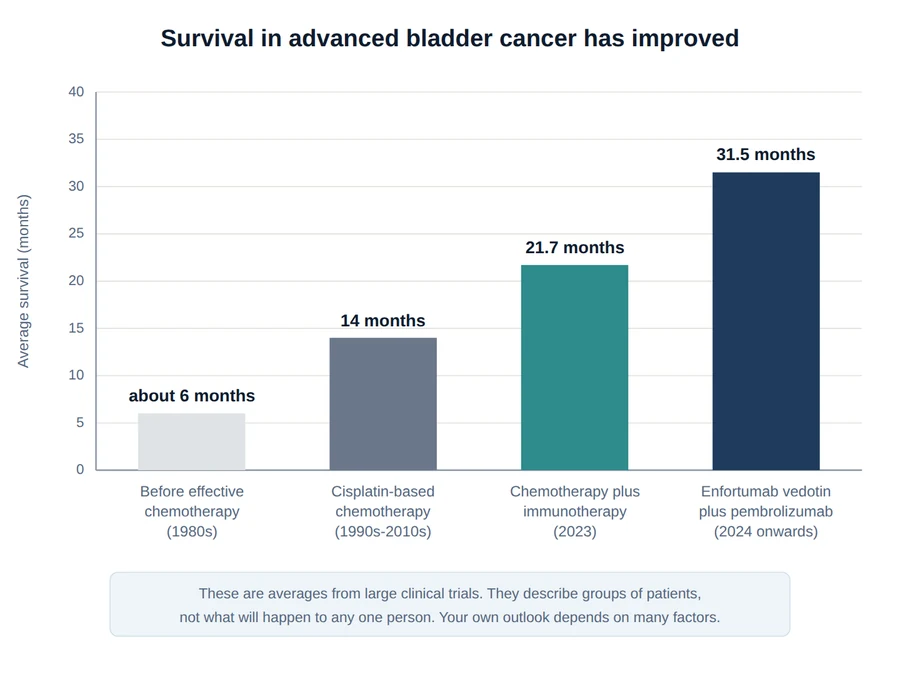
Before effective chemotherapy existed, average survival with advanced bladder cancer was measured in months. In the 1980s, cisplatin-based chemotherapy became the standard of care and extended average survival to somewhere around 14 months.
That figure then barely moved for close to thirty years. Numerous trials tried to improve on cisplatin-based chemotherapy and did not succeed. Gemcitabine with cisplatin became the most commonly used combination because it caused fewer side effects. However, for patients whose kidneys or general health could not tolerate cisplatin, options were limited.
Immunotherapy enters the picture
Immunotherapy works differently from chemotherapy. Rather than attacking cancer cells directly, these drugs release a brake that cancers use to hide from the immune system, allowing your own immune cells to recognise and attack the cancer. Because the mechanism is different, the pattern of benefit is different too: a minority of patients respond exceptionally well and for a long time, which is rarely seen with chemotherapy alone.
In a large trial reported in 2023, adding the immunotherapy drug nivolumab to gemcitabine and cisplatin improved average survival from 19 months to 22 months. This was a genuine advance, and the first time chemotherapy had been meaningfully improved upon in this setting. However, not everyone benefits equally from immunotherapy, and predicting who will respond has proved difficult. Some immune-related side effects can also be serious and, rarely, lifelong.
The current standard
The larger change came from combining two newer approaches. Enfortumab vedotin is an antibody-drug conjugate — a treatment that works rather like a guided delivery system. An antibody seeks out a protein found on bladder cancer cells and delivers a chemotherapy drug directly to those cells. It is given together with pembrolizumab, an immunotherapy drug.
In a trial comparing this combination with standard chemotherapy, average survival rose from 16 months to 31.5 months — roughly doubling. The time before the cancer started growing again also roughly doubled, and responses lasted around two years on average. These results were clear enough that the combination became the recommended first treatment for advanced bladder cancer, and it is now offered regardless of whether a patient could have tolerated cisplatin.
| Era | Treatment | Average survival |
|---|---|---|
| Before the 1980s | Before effective chemotherapy | About 6 months |
| 1990s to 2010s | Cisplatin-based chemotherapy | About 14 months |
| 2023 | Chemotherapy plus immunotherapy | 22 months |
| 2024 onwards | Enfortumab vedotin plus pembrolizumab | 31.5 months |
Side effects worth knowing about
Enfortumab vedotin plus pembrolizumab (EVP), while highly effective, carries a risk of major side effects in more than half of patients. Enfortumab vedotin commonly causes a skin rash, tingling or numbness in the hands and feet, and raised blood sugar. The nerve symptoms are the ones to report early, because adjusting the dose promptly usually prevents them from becoming lasting.
Immunotherapy can cause the immune system to attack healthy tissue, producing inflammation in the bowel, skin, thyroid or elsewhere. This is uncommon and treatable when caught early — which is why any new symptom should be reported rather than waited out.
Treatment aimed at symptoms
Alongside treatment directed at the cancer, there is treatment directed at how you feel. A short course of radiotherapy can settle bleeding from the bladder or relieve bone pain effectively. Specialist teams — variously called palliative care or supportive care — are expert at managing pain, appetite, fatigue and breathlessness.
Being referred to such a team does not mean treatment is being withdrawn, or that you are near the end of life. Evidence from several cancers shows that patients who see these teams early report better quality of life, and in some studies live longer. Asking for that referral early is a reasonable and practical thing to do.
Have a question about this condition?
Dr Tan consults at SJMC, Kuala Lumpur.
For the diagnosis itself, see bladder cancer: symptoms, tests and types.