Lower Urinary Tract Symptoms (LUTS)
Common urinary symptoms in men and women — what they mean, how they are assessed, and the treatments that can help.
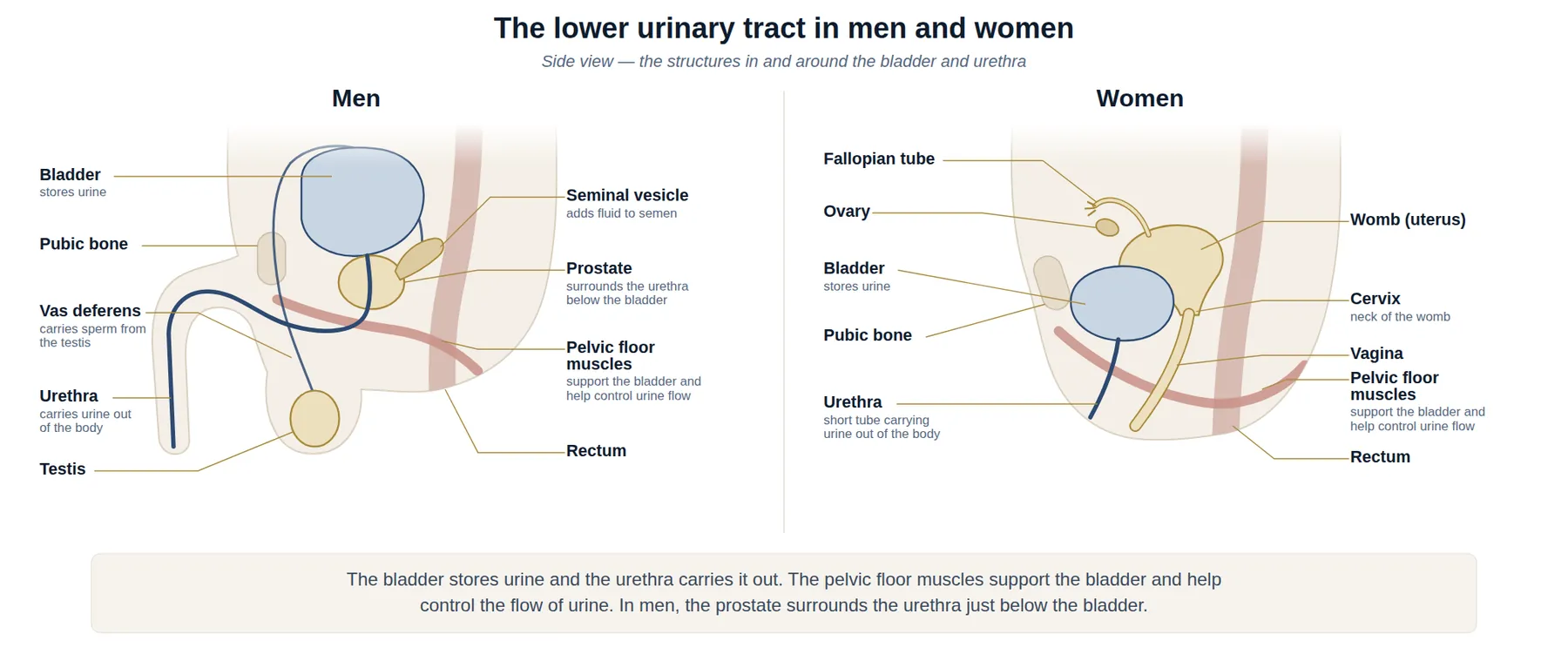
Needing to pass urine more often, getting up at night, a sudden urge to go, a weak stream or a feeling that the bladder has not fully emptied are very common, and become more so with age. Together these are called lower urinary tract symptoms, or LUTS. They affect both men and women. They are rarely dangerous, but they can have a real effect on sleep, work and quality of life — and there is a lot that can be done to help.
How common are LUTS?
Urinary symptoms are extremely common. In a large population survey of more than 19,000 adults in Europe and Canada (the EPIC study), almost two in three people reported at least one urinary symptom. Getting up at night to pass urine (nocturia) was the most common, affecting around half of both men and women. Symptoms related to storing urine were more common than those related to emptying the bladder, in both sexes.
Having symptoms does not mean they will inevitably need treatment. In a Mayo Clinic community study that followed more than 2,000 men for up to six years (the Olmsted County study), fewer than 1 in 10 received any treatment for their urinary symptoms — although treatment became much more common with age, rising to nearly 1 in 4 men aged 70 or older. Most men who were treated started with medication rather than surgery.
Types of symptoms
LUTS are grouped by what the bladder is doing when the symptom occurs.
| Type | What it relates to | Typical symptoms |
|---|---|---|
| Storage (irritative) symptoms | The bladder while it is filling and holding urine | Passing urine more often during the day (frequency) Getting up at night to pass urine (nocturia) A sudden, strong need to go that is hard to put off (urgency) Leaking with urgency (urge incontinence), or with coughing, sneezing or exercise (stress incontinence) |
| Voiding (obstructive) symptoms | The bladder while it is emptying | A weak or slow stream Difficulty or delay in starting (hesitancy) A stream that stops and starts (intermittency) Straining to pass urine |
| Post-micturition symptoms | Just after passing urine | A feeling that the bladder has not emptied fully Dribbling after you think you have finished |
Common causes. In men, voiding symptoms are often linked to the prostate narrowing the urinary channel as it enlarges with age (benign prostatic enlargement). In women, symptoms are predominantly storage symptoms — mainly frequency and urgency — often related to an overactive bladder. In both sexes, symptoms can also be caused or worsened by an overactive bladder, urine infection, drinking habits, some medicines, diabetes, neurological conditions, or the body producing too much urine at night. Many people have a mixture of symptoms, and identifying which are most troublesome helps guide treatment.
When to seek advice promptly. Please see a doctor without delay if you have blood in your urine, are unable to pass urine, have pain or a fever with your symptoms, or your symptoms are getting rapidly worse.
Assessment
The aim of assessment is to understand your symptoms, how much they bother you and their likely cause — and to rule out other conditions. It usually includes:
- Your history and a symptom questionnaire, such as the International Prostate Symptom Score (IPSS) for men, which measures how severe symptoms are and how much they affect quality of life.
- A bladder diary: recording when and how much you drink and pass urine over a few days. This is particularly helpful for night-time symptoms, as it can show whether the body is simply making too much urine overnight.
- Examination: of the abdomen, and usually of the prostate in men or a pelvic examination in women.
- Urine and blood tests: a urine test to check for infection or blood and, for men where appropriate, a PSA blood test after discussion.
- Urinary flow rate test: you pass urine into a special toilet or funnel that measures the strength and pattern of your stream. A weak flow can suggest the urinary channel is narrowed, or that the bladder muscle is not squeezing strongly.
- Bladder scan after passing urine (post-void residual): a quick, painless ultrasound scan of the lower abdomen that shows how much urine is left in the bladder after you have been to the toilet.
Urodynamic tests. For some people, more detailed bladder pressure tests (urodynamics) may be helpful. These use fine tubes to measure the pressure in the bladder as it fills and empties, and can show whether symptoms are due to a blockage, an overactive bladder, a weak bladder muscle or leakage. They are not needed routinely, but may be recommended when the cause is unclear, when initial treatment has not helped, or before surgery in selected cases.
Lifestyle measures and monitoring
If symptoms are mild, simple measures and regular review may be all that is needed:
- adjusting how much and when you drink — for example, drinking less in the evening, without cutting down so much overall that you become dehydrated
- reducing caffeine, fizzy drinks and alcohol, which can irritate the bladder
- bladder training — gradually extending the time between toilet visits
- pelvic floor muscle exercises — particularly helpful for leakage
- for men, double voiding (trying again a moment after finishing) and gently emptying the urethra to reduce after-dribble
Medical treatment
If symptoms remain bothersome, medication is often the next step. The choice depends on which symptoms are most troublesome and, in men, the size of the prostate.
| Type of medicine | Who it is for | How it helps | Things to know |
|---|---|---|---|
| Alpha-blockers (e.g. tamsulosin) | Men | Relax the muscle in the prostate and bladder neck to improve the flow | Work within days to weeks; can cause dizziness or reduced ejaculation |
| 5-alpha reductase inhibitors (finasteride, dutasteride) | Men with a larger prostate | Gradually shrink the prostate and reduce the long-term risk of retention or surgery | Take several months to work; can affect sex drive or erections; halve the PSA reading |
| Bladder-calming medicines (antimuscarinics or beta-3 agonist) | Men and women | Reduce urgency, frequency and urge leakage | Antimuscarinics can cause a dry mouth or constipation, and long-term use of some has been linked with memory problems in older people, although this has not been shown to be the cause; the beta-3 agonist mirabegron can raise blood pressure, so this is checked; bladder emptying is checked first |
| Tadalafil | Men | Can improve urinary symptoms, particularly in men who also have erection problems | Not suitable with some heart medicines |
| Desmopressin | Men and women | Reduces the amount of urine made overnight, when this is the main problem | Needs blood tests to monitor salt (sodium) levels, and blood pressure checks, particularly in older people |
| Vaginal oestrogen | Women after the menopause | Can help urgency, frequency and recurrent urine infections | Applied locally as a cream, tablet or ring |
Medicines can also be combined — for example, an alpha-blocker with a 5-alpha reductase inhibitor in men with a larger prostate.
Procedures and surgery
For men with prostate enlargement, procedures may be recommended if symptoms remain bothersome despite medication, if you prefer not to take long-term medication, or if complications develop, such as being unable to pass urine. Options include TURP, UroLift, Rezum water vapour therapy, holmium laser enucleation (HoLEP), robotic simple prostatectomy, and prostate artery embolisation. How these compare for different prostate sizes is explained on the Benign Prostatic Enlargement page, and each procedure is described on the Benign Prostatic Enlargement treatments page.
For an overactive bladder that has not responded to medicines, options for both men and women include injections of botulinum toxin into the bladder wall, or treatments that gently stimulate the nerves controlling the bladder.
Have a question about this condition?
Dr Tan consults at SJMC, Kuala Lumpur.