Benign Prostatic Enlargement (BPE)
Why the prostate grows with age, when it causes problems, and how prostate size shapes the treatment options.
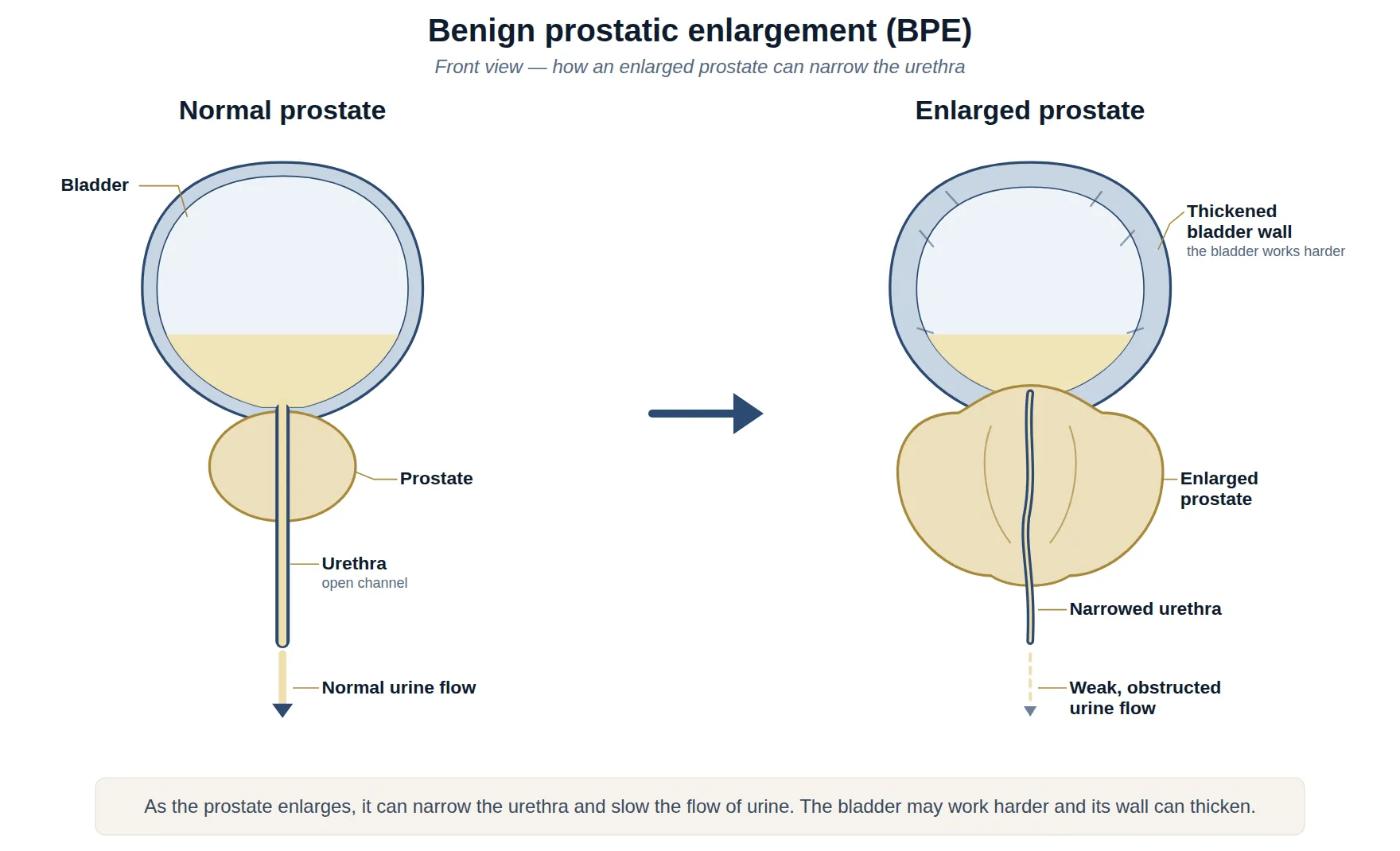
The prostate is a small gland that sits just below the bladder and surrounds the urethra — the tube that carries urine out of the body. In most men it slowly grows larger with age. This non-cancerous growth is called benign prostatic enlargement (BPE). You may also hear it called benign prostatic hyperplasia (BPH), which is the name for the change seen under the microscope.
Many men with an enlarged prostate have few or no symptoms. For others, the enlarged gland narrows the urinary channel and causes bothersome lower urinary tract symptoms. This page focuses on the prostate itself — how common enlargement is, whether it gets worse, its relationship with prostate cancer, and how its size guides treatment.
How common is it?
Prostate enlargement is a normal part of ageing. A combined analysis of more than 1,000 prostates found the changes of BPH in only 8% of men in their thirties, but in half of men aged 51 to 60 — and they become more common still with age. A young adult prostate weighs around 20 grams; in older men it can grow much larger, although only around 4% of men over 70 have a prostate larger than 100 grams.
The size of the prostate does not always match the symptoms. Some men with a large prostate have few problems, while others with only modest enlargement have troublesome symptoms.
Will it get worse?
BPE tends to progress slowly, although this is not the case for every man. In the Olmsted County study, men were more likely to need treatment over up to six years of follow-up if they had an enlarged prostate (over 30 mL), a weak urinary flow (under 12 mL per second) or moderate to severe symptoms — each of these was independently linked to a higher chance of treatment.
Less commonly, BPE can lead to complications, including:
- Acute urinary retention: suddenly being unable to pass urine, which is painful and needs urgent medical attention.
- Chronic retention: the bladder gradually failing to empty fully, or losing the ability to contract properly, sometimes without pain.
- Other complications: repeated urine infections, bladder stones, bleeding from the prostate, and — rarely — pressure on the kidneys affecting kidney function.
BPE and prostate cancer
BPE is not cancer. It does not turn into cancer. However, both conditions are common in the same age group, so a man can have both at the same time. An enlarged prostate can also raise the PSA level, which is one reason a raised result needs careful interpretation — see Elevated PSA.
Can BPE medicines lower the risk of prostate cancer? In the Prostate Cancer Prevention Trial, almost 19,000 men took finasteride or a placebo for seven years. Finasteride reduced the chance of prostate cancer being diagnosed by around a quarter. The first report raised concern because higher-grade cancers were found slightly more often in the finasteride group (6.4% compared with 5.1%). With up to 18 years of follow-up, however, there was no difference in overall survival, or in survival after a prostate cancer diagnosis, between the two groups — and the higher-grade finding is now thought to reflect cancers being easier to detect in a prostate that finasteride has made smaller. In line with guidelines, finasteride is used to treat BPE and is not routinely prescribed solely to prevent prostate cancer today.
If prostate cancer is diagnosed. Existing urinary symptoms from BPE can influence the choice of cancer treatment. Radiotherapy-based treatments can make urinary symptoms worse, particularly in men who already have troublesome symptoms or a large prostate. Robotic prostatectomy removes the whole prostate, including the enlarged tissue causing the blockage, so men with bothersome urinary symptoms before treatment may favour surgery over other options. See treating localised prostate cancer and robotic prostatectomy.
Measuring the prostate
Knowing the size and shape of the prostate helps decide which treatments are suitable. The prostate may be:
- Felt during a rectal examination, which gives an approximate idea of size.
- Measured with an ultrasound scan (through the abdomen or the back passage), or on an MRI scan if one has been done for another reason, such as a raised PSA.
- Looked at from the inside with a cystoscopy — a thin telescope passed into the urethra — before some procedures. This shows the shape of the prostate, including whether there is an enlarged middle lobe, which affects whether some treatments are suitable.
Tests of how well you pass urine — such as the flow rate and bladder scan — are described on the Lower Urinary Tract Symptoms page.
Treatment and prostate size
Treatment is guided by how much the symptoms bother you, whether complications have developed, and the size and shape of the prostate. Lifestyle measures and the full range of medicines are covered on the Lower Urinary Tract Symptoms page.
Medicines that shrink the prostate. 5-alpha reductase inhibitors (finasteride or dutasteride) gradually reduce the size of a larger prostate. In the large MTOPS trial, men taking finasteride — alone or combined with an alpha-blocker — had a lower long-term risk of urinary retention and of needing surgery, and combination treatment reduced the overall risk of the condition progressing by 66% compared with placebo. These medicines take several months to work and halve the PSA reading, which is important to note.
Procedures. If a procedure is needed, the size and shape of the prostate help determine which options are suitable:
| Procedure | Prostate size | Ejaculation | Catheter afterwards |
|---|---|---|---|
| UroLift | Under 80 mL, without an obstructing middle lobe | Preserved in the vast majority | Often not needed, or removed the same day or next morning |
| Rezum water vapour therapy | Under 80 mL, including an obstructing middle lobe | Preserved in most men | Usually for 5–7 days; benefit builds over 1–3 months |
| TURP | Up to 100 mL | Usually retrograde (dry orgasm) | Usually 1–2 days |
| HoLEP (laser enucleation) | Almost any size, but generally reserved for very large prostates (over 100 mL) | Usually retrograde (dry orgasm) | Usually 1–2 days |
| Robotic simple prostatectomy | Very large — typically over 100 mL | Usually retrograde (dry orgasm) | Around 7–10 days |
| Prostate artery embolisation (PAE) | Selected men, including those who wish to avoid surgery | Usually preserved | Not usually needed |
This is a simplified guide. The most suitable option for you will be discussed at your consultation.
Each surgical procedure — what it involves, its risks and recovery — is described in detail on the Benign Prostatic Enlargement treatments procedures page.
Have a question about this condition?
Dr Tan consults at SJMC, Kuala Lumpur.