Treating Muscle-Invasive Bladder Cancer
The two main approaches when bladder cancer has reached the muscle wall — how the choice is made, and what life looks like afterwards.
Muscle-invasive bladder cancer means the cancer has grown into the muscle wall of the bladder. It is a serious diagnosis that needs prompt and substantial treatment — but it is often curable. This article explains the two main approaches, how the decision between them is made, and what to expect afterwards.
Drug treatment before the main treatment
For most people, treatment begins with a course of drug treatment given through a drip into a vein, before the main treatment to the bladder. Because it is given beforehand, it is called neoadjuvant therapy. Its purpose is to treat cancer cells that may already have travelled elsewhere in the body but are too small to show up on any scan.
For many years the standard was cisplatin-based chemotherapy. More recently, newer combinations have become increasingly preferred — enfortumab vedotin with pembrolizumab (EVP), or gemcitabine, cisplatin and durvalumab (Gem-Cis-Durva). These combine chemotherapy with newer targeted and immune-based medicines.
The benefit is real: large clinical trials show these approaches improve the chance of being alive two years later, with an absolute survival advantage of at least 6–7% at two years compared with older treatment. Your team will discuss which combination is most suitable for you, taking into account the extent of the cancer and your general health.
Removing the bladder
After drug treatment, the most established option is to remove the bladder — an operation called radical cystectomy — together with the nearby lymph glands. In men, the prostate is usually removed as well; in women, the operation may include the womb and part of the vaginal wall. In selected patients, part of the prostate or vagina can be preserved, which is called organ-sparing cystectomy. Radical cystectomy offers the most predictable control of cancer within the bladder.
The operation can be performed through a single open cut in the abdomen, or with robotic assistance, where the whole operation is carried out through six small incisions. Either way, the surgeon performs every movement — the robot does not act on its own.
Our group has studied this comparison closely, both in our own analyses and by pooling the results of every randomised trial worldwide. Patients who had robotic surgery lost less blood, needed fewer transfusions, had fewer wound complications and blood clots, and spent less time in hospital in the 90 days after surgery. Our data also suggest that less fit patients — for example those with anaemia or other medical problems — tolerated the operation better when it was done robotically.
Importantly, cancer control and long-term survival are equivalent between the two. Both are good operations, and the experience of the surgeon and hospital matters more than the platform used. Research has shown that the robotic approach can help make the most of enhanced-recovery programmes, so patients return to normal more quickly.
Diverting the urine
Once the bladder is removed, urine needs a new route out of the body. A short segment of your own small bowel is used to create this, and there are two main options.
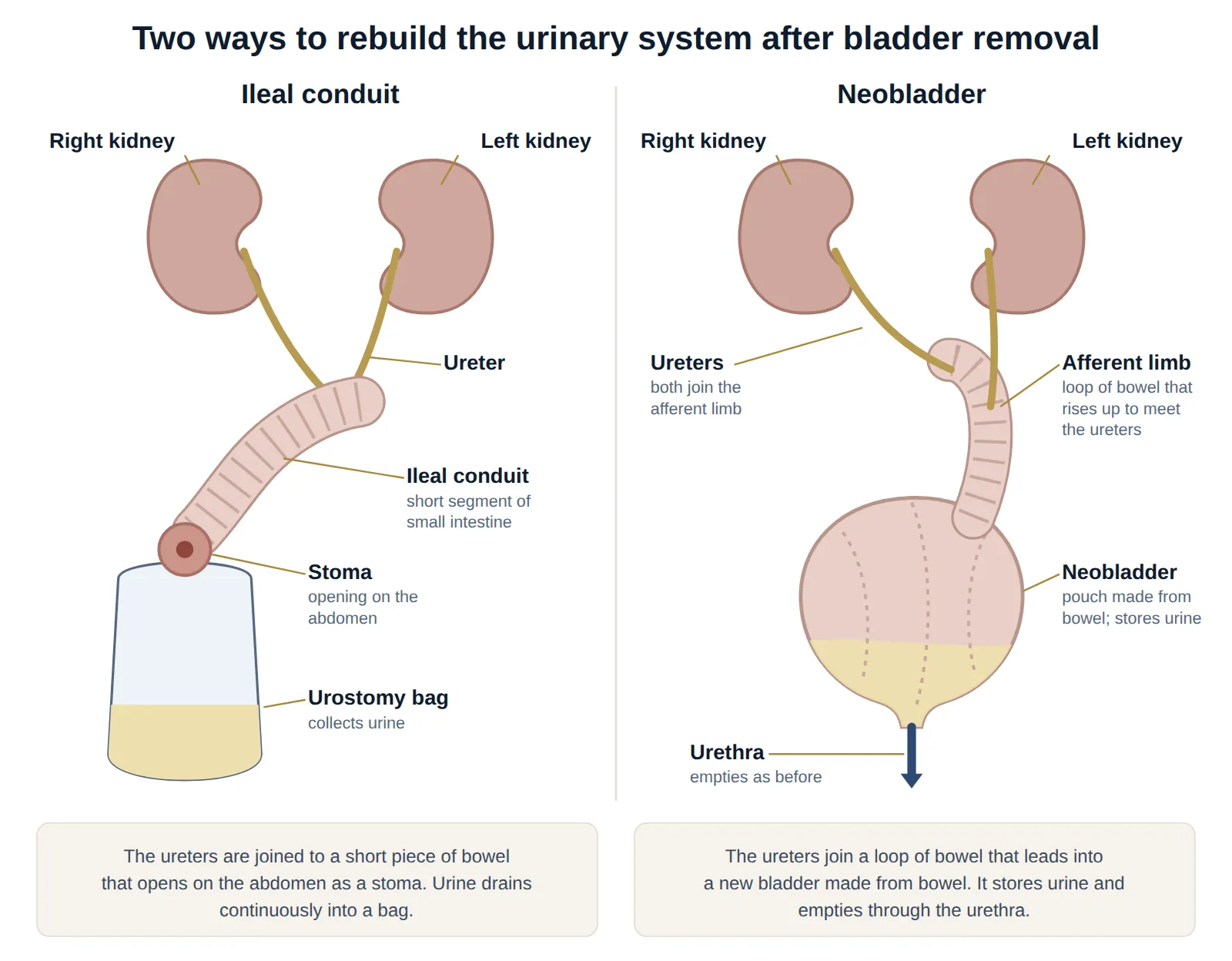
An ileal conduit uses a short segment of bowel as a pipe. The drainage tubes from the kidneys join one end, and the other is brought to the skin as a small opening called a stoma. Urine drains continuously into a lightweight bag worn on the abdomen. It is the simpler operation with fewer long-term complications, and a stoma nurse teaches you to manage it before you go home.
A neobladder uses a longer segment of bowel folded into a pouch and joined to your own urethra, so you pass urine in the usual way with no bag. It is a longer operation and needs suitable anatomy. Leakage at night is common, and some people need to pass a catheter to empty fully. It suits motivated patients who understand the trade-offs. It is worth knowing that a neobladder does not squeeze the way a normal bladder does, so there can be long-term issues with emptying, a need for catheters, and recurrent urine infections.
The right choice depends on your cancer, your kidney function, your dexterity, and what matters most to you. We have reviewed how neobladder reconstruction has evolved and described the complications of both approaches in detail, and we have tracked how quality of life recovers after surgery — it typically dips in the first months and then returns towards where it started.
Keeping the bladder
Some patients can be treated without removing the bladder, using three treatments together — an approach called trimodal therapy. A thorough removal of the tumour through the urethra is followed by radiotherapy to the bladder given over several weeks, with low-dose chemotherapy alongside to make the radiotherapy more effective.
This works best for a single tumour that has been completely removed, without CIS, in a bladder that works well and with no blockage of the kidneys. In carefully selected patients, five-year survival is broadly comparable to surgery. It requires lifelong cystoscopic monitoring, and if the cancer returns, removing the bladder may still become necessary.
Newer drug treatments now mean more patients achieve a complete response — no visible cancer remaining — after the initial course. Some may then consider not having any further local treatment to the bladder. However, there are real concerns about this approach: it remains an area of active research and is not standard of care, because the stakes are high if the disease returns. It is considered only in very selected cases.
A third option is worth mentioning because it is often overlooked. Partial cystectomy removes only the affected portion of the bladder, leaving the rest in place. We have reviewed which patients are suited to it — principally those with a single tumour in a favourable position, such as within a bladder pouch (diverticulum) or at the top of the bladder — but it is not appropriate for most people.
| What to compare | Removing the bladder | Keeping the bladder |
|---|---|---|
| Main treatment | Surgery, often after chemotherapy | Radiotherapy with chemotherapy |
| Hospital stay | 4–6 nights | Outpatient, over 4–7 weeks |
| Passing urine | Via stoma bag or neobladder | Your own bladder is kept |
| Ongoing checks | Scans and blood tests | Regular cystoscopy for life, scans, blood and urine tests |
| If it comes back | Further treatment as needed | Surgery may still be needed, which is then more challenging |
Effects on sexual function and fertility
These operations affect sexual function, and it is a subject that is too often left undiscussed when it should not be. In men, removing the prostate almost always affects erections; nerve-sparing techniques help some but not all patients. In women, the operation can alter vaginal anatomy and sensation. Both men and women become infertile after cystectomy, so if having children may matter to you, raise it before treatment starts. Organ-sparing approaches may be an option in selected patients and can help preserve sexual function.
Recovery and outlook
After cystectomy, most people stay in hospital for four to six nights and feel substantially recovered by two to three months. Fatigue is normal and is often the last thing to improve. Enhanced-recovery programmes — eating and walking early rather than resting in bed — have shortened recovery considerably. Our own work showed that combining robotic surgery with such a programme improved outcomes not through any single dramatic change, but by accumulating many small ones — an approach we described as aggregating marginal gains. Improving your fitness before surgery, sometimes called prehabilitation, contributes to the same effect.
Roughly half of patients treated for muscle-invasive disease are alive and free of cancer five years later, and the figure is higher when the cancer is confined to the bladder wall and the lymph glands are clear. Your own outlook depends on the stage found at surgery and how the tumour responded to chemotherapy. If the removed tissue shows more advanced disease than expected, additional treatment after surgery may be recommended.
Have a question about this condition?
Dr Tan consults at SJMC, Kuala Lumpur.
If the cancer has spread beyond the bladder, see advanced and metastatic bladder cancer.