Treating Non-Muscle-Invasive Bladder Cancer
How risk groups guide treatment and monitoring — tumour removal, medicine placed into the bladder, and long-term surveillance.
Non-muscle-invasive bladder cancer is the most common form of bladder cancer, accounting for around three-quarters of new diagnoses. It sits in the bladder lining and has not reached the muscle wall. The outlook is generally good, but the cancer commonly comes back, so regular monitoring is important.
Working out your risk group
After your transurethral resection of bladder tumour (TURBT), you will be placed into a risk group. This is not a prediction of how long you will live. It is a practical tool that estimates two things: how likely the cancer is to come back, and how likely it is to become more serious over time.
The factors considered are the grade (how aggressive the cells look), the stage (the depth of invasion), the size of the tumour, how many tumours there were, whether this is a first occurrence or a recurrence, and whether carcinoma in situ is present. Carcinoma in situ — usually shortened to CIS — is a flat, high-grade patch in the lining. It does not form a lump, which makes it harder to see, and it behaves aggressively, so its presence places you in the high-risk group.
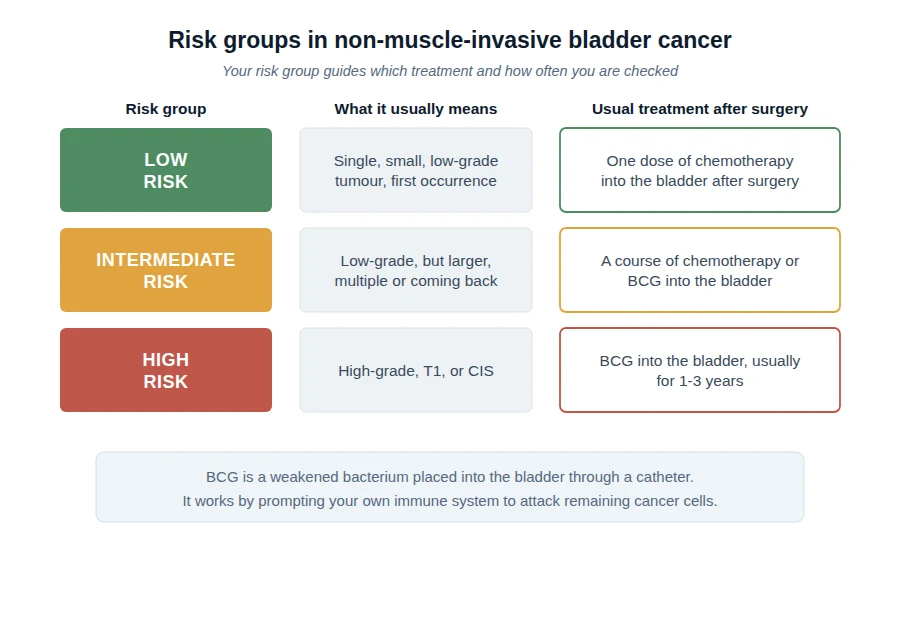
In broad terms, the low-risk group is a new patient with a single, small, low-grade tumour; the intermediate-risk group is typically low-grade cancer that is larger, multiple, or has come back; and the high-risk group is high-grade, T1, or CIS disease.
Low- and intermediate-risk tumours are rarely life-threatening, although recurrence is common — around two in five patients develop a recurrence. High-risk cancer carries roughly a 20% risk of progressing to muscle-invasive disease and a 50% risk of recurrence, which makes it considerably more serious.
Medicine placed into the bladder
Most people are offered treatment given directly into the bladder through a catheter — a soft tube passed along the urethra. This is called intravesical therapy (treatment placed inside the bladder). Because the medicine stays in the bladder and is generally not absorbed into the body, side effects elsewhere in the body are uncommon.
Chemotherapy into the bladder — usually mitomycin C or gemcitabine — kills any cells left floating after surgery. A single dose given within 24 hours of TURBT lowers the chance of recurrence and is often all that low-risk patients need. A longer course of weekly treatments may be used for intermediate-risk disease.
BCG is a weakened form of a bacterium originally developed as a tuberculosis vaccine. Rather than killing cancer cells directly, it provokes a strong immune reaction in the bladder lining, so your own immune system does the work. It is the most effective intravesical treatment for high-risk disease. Treatment begins with six weekly instillations (doses placed into the bladder), followed by maintenance doses spread over one to three years.
What treatment feels like
Each instillation takes a few minutes. You hold the fluid in your bladder for one to two hours, then pass urine as normal, and most people drive themselves home afterwards.
Common effects include needing to pass urine more often and more urgently, a burning sensation, and some blood in the urine for a day or two. With BCG, flu-like symptoms — a mild fever and aching — are common on the first day and usually settle. Contact your team if you have a fever above 38.5°C, shaking chills, or symptoms lasting beyond 48 hours.
What to expect over time
Recurrence is common and does not mean treatment has failed. Many people have one or more recurrences over the years, each dealt with by a further TURBT. What matters more is progression — the cancer becoming muscle-invasive — which is much less common, and is what treatment and surveillance aim to prevent.
For low-risk disease the outlook is excellent, with survival at five years above 90%. High-risk disease needs closer attention, and if BCG does not control it, removing the bladder may be recommended to prevent progression. That conversation is a difficult one, but having it at the right moment gives the best chance of a good outcome.
Your monitoring schedule
Surveillance means regular cystoscopy — the same flexible telescope examination used at diagnosis, performed in clinic with local anaesthetic gel. How often depends on your risk group.
| Risk group | First 2 years | Years 3–4 | After that |
|---|---|---|---|
| Low | At 3 months, then 6–9 months | Yearly | Stop after 5 years |
| Intermediate | Every 3–6 months | Every 6–12 months | Yearly for 10 years |
| High | Every 3–4 months | Every 6 months | Yearly |
High-risk patients also have periodic scans of the kidneys and drainage tubes, since the same lining extends throughout the urinary tract. Attending these appointments matters a great deal, because recurrences found early are usually straightforward to treat.
Many people find the days before each cystoscopy anxious. This is a normal reaction rather than a sign of not coping, and for most people the checks become less frequent over time.
When BCG is in short supply
BCG has been subject to worldwide shortages for years, as very few manufacturers produce it. If supply is limited, we may use a reduced dose or a shorter schedule. Studies of reduced-dose BCG suggest similar effectiveness, so this should not compromise your care.
We have also shown that sequential gemcitabine and docetaxel — two chemotherapy drugs given into the bladder one after the other — is a reasonable alternative to BCG for intermediate-risk disease. We are currently evaluating this approach for high-risk bladder cancer in a large randomised clinical trial in the UK (COBRA), funded by the National Institute for Health Research.
What happens when BCG does not work
Patients whose cancer comes back after BCG have a variable outlook. We have reported that well-selected patients who choose a bladder-preserving approach over bladder removal can have similar survival outcomes. Caution is important, however, because bladder removal is recommended for the most aggressive form — known as BCG-unresponsive disease — because the risk of recurrence with further bladder-sparing treatment is high. Sequential gemcitabine and docetaxel is a commonly used option for patients whose cancer has not responded to BCG. Our group has previously led trials of chemotherapy delivered into the bladder, although the results have been mixed.
Active surveillance for small recurrences
Not every recurrence needs an operation. If you have small, low-grade tumours that have behaved predictably, it may be reasonable to simply monitor them at intervals rather than removing each one under anaesthetic. Our work has helped identify which patients can be monitored safely in this way. It is only appropriate for low-grade disease, can be stopped at any point if the appearance changes, and is always a shared decision. If you develop blood in the urine, or the tumours grow in size or number, they would then be removed.
What you can do
Stopping smoking is the single most valuable step. Continuing to smoke increases the chance of the cancer coming back and of it progressing. Support to quit is available and is worth accepting — and it is never too late for it to help. Drinking plenty of fluid is sensible, and keeping to your appointment schedule is an important part of your ongoing care.
Have a question about this condition?
Dr Tan consults at SJMC, Kuala Lumpur.