Blood in the Urine (Haematuria)
What it means, why it needs investigating, and what the tests involve.
What it means
Few things are as unsettling as seeing blood in your urine. The good news is that most causes are not cancer. However, blood in the urine should never be ignored, because in a small but significant number of people it is the first and only sign of cancer in the urinary tract. This article explains what blood in the urine means, why it needs to be investigated, and what the tests involve.
Two kinds of blood in the urine
Blood in the urine (haematuria) is classified into:
- Visible haematuria means you can see the blood. The urine may look pink, red, or the colour of tea or cola. You may see it once, or on and off over weeks. Even a single episode matters, even if the urine clears up completely afterwards.
- Non-visible haematuria means the blood can only be detected by a test. The urine looks entirely normal to you, but a dipstick or laboratory analysis picks up red blood cells. This is often found by chance during a health check.
Visible bleeding carries a considerably higher chance of underlying cancer than non-visible bleeding, so it is usually investigated more urgently. Both, however, deserve proper assessment.
What causes it?
Many conditions cause bleeding, and most are not serious. A urinary tract infection is among the commonest. Kidney and bladder stones can scratch the lining of the urinary tract and can be associated with pain. In men, an enlarged prostate is a frequent cause of blood in the urine. Other causes include vigorous exercise, some medicines, and certain kidney conditions.
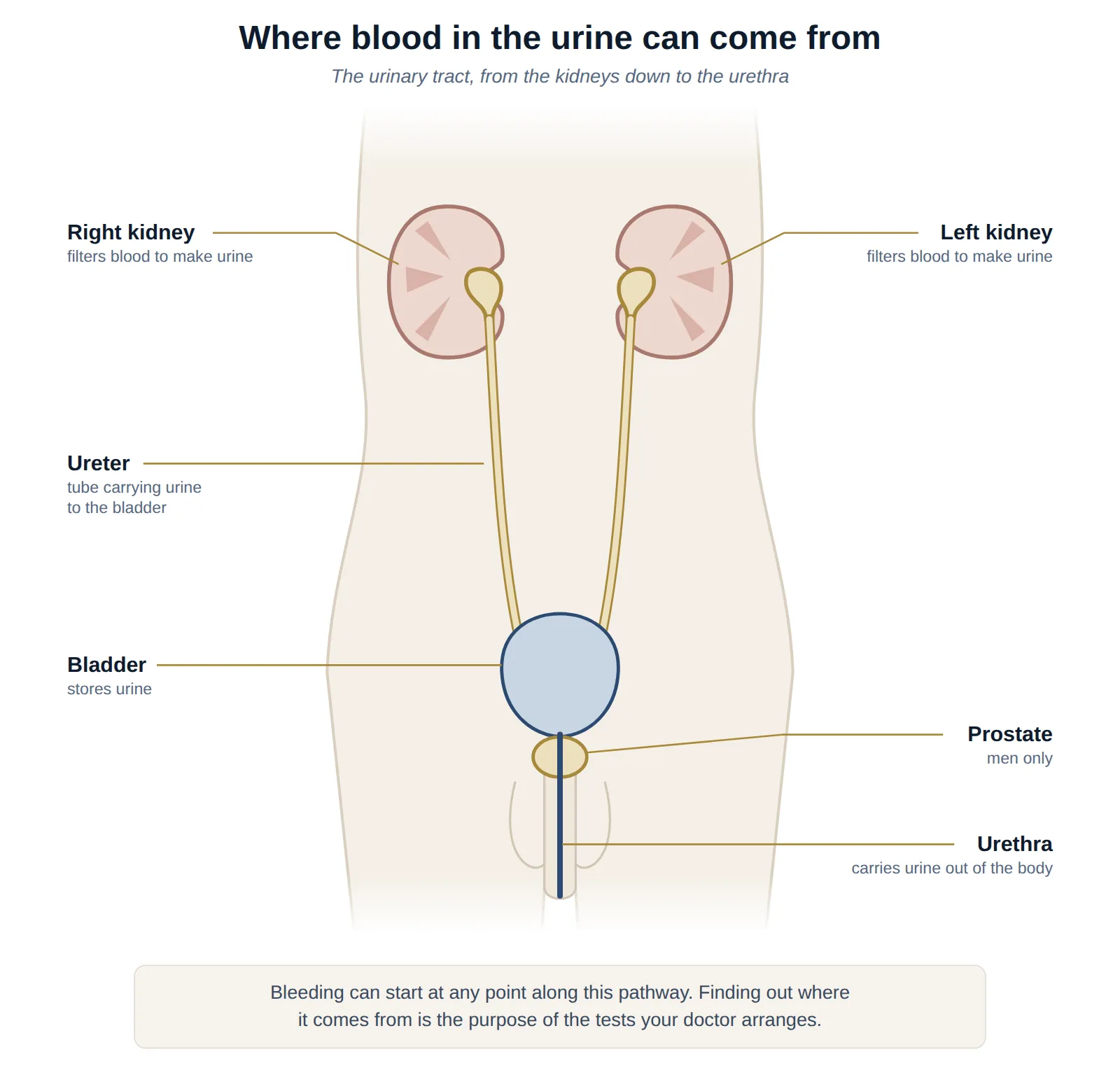
Cancers of the bladder, kidney, or ureters (tubes draining the kidneys to the bladder) account for a minority of cases, but blood in the urine requires evaluation by a urologist. Our own research group studied this question directly in the DETECT I study, following 3,556 patients referred with haematuria across more than 40 hospitals. A urinary tract cancer was identified in one in ten. Among those with visible bleeding the figure was closer to one in seven, while for non-visible bleeding it was around one in thirty. Bladder cancer accounted for most of the cancers identified.
Certain factors increase the likelihood of identifying cancer in patients with blood in the urine. These include being older, being male, and having smoked, since smoking is the strongest known risk factor for bladder cancer. Previous exposure to industrial chemicals used in the dye, rubber or paint industries also matters.
| Cause | Typical features |
|---|---|
| Urinary infection | Burning, urgency, needing to pass urine often |
| Kidney or bladder stones | Sudden severe pain in the side, back or lower abdomen |
| Enlarged prostate (men) | Slow stream, difficulty starting, getting up at night |
| Bladder cancer | Often painless bleeding, may come and go |
| Kidney cancer | Often no symptoms at all; frequently found following scans |
| Vigorous exercise or medicines | Settles after stopping or resting |
Why it must be checked
Bladder cancer often causes no pain. Painless bleeding that stops on its own is a classic pattern, and it is precisely this reassuring behaviour that leads people to delay seeking help. Cancers of the urinary tract are highly treatable when found early, and much harder to treat once they have grown deeper into the muscle or spread to other organs in the body. Getting checked promptly is the single most useful thing you can do.
The tests you can expect
Your assessment is tailored to your age, sex, smoking history, and whether the bleeding was visible. Most people will have some combination of the following.
- A urine test looks for infection first, since treating an infection may resolve the problem. Blood tests check how well your kidneys are working.
- A cystoscopy is a look inside the bladder using a thin flexible telescope passed through the urethra, the tube you pass urine through. Local anaesthetic gel is used, and it usually takes only a few minutes in the clinic. Most people describe it as uncomfortable rather than painful. It is the most reliable way to see the bladder lining directly. In DETECT I, ultrasound imaging missed one in two patients who had a diagnosis of bladder cancer, and CT imaging missed one in five cancers of the bladder.
- Imaging examines the kidneys and the drainage tubes, which a cystoscopy cannot reach. This may be an ultrasound scan, which uses sound waves and involves no radiation, or a CT urogram, a detailed X-ray scan with a dye injection that outlines the whole urinary tract. CT gives more detail but involves radiation and a dye injection. Our analysis of the DETECT I patients showed that, for people with non-visible bleeding, ultrasound of the kidneys and bladder detected the cancers that mattered, and that routine CT urography added little while exposing patients to radiation. Guidelines have moved in this direction, so you may reasonably be offered ultrasound rather than CT.
Urine cytology, in which the laboratory examines cells shed into the urine, was once routine. We examined its value in the same patients and found it added little when cystoscopy and imaging were already being performed, so it is no longer used routinely in many centres.
A risk-stratified approach
Guidance on who should be investigated following a presentation of blood in the urine varies between countries. We have developed the Haematuria Cancer Risk Score, a tool that combines your age, sex, smoking history and type of bleeding into an individual estimate of the risk of cancer. This tool has been externally validated and, when combined with ultrasound imaging, effectively rules out the presence of bladder cancer in more than 98% of cases in those studies, and identified a group in whom cystoscopy might reasonably be avoided in more than 25% of cases. Work of this kind aims to spare people unnecessary procedures while making certain that those who need investigation receive it promptly. This approach still requires prospective validation, and this work is ongoing with our collaborators in the UK; it has not yet been incorporated into guidelines. However, it may help some patients in deciding about proceeding with a cystoscopy.
Preparing for your appointment
Note when the bleeding happened, whether you can see it, and whether there was any pain or blood clots. Bring a list of your medicines, including blood thinners such as aspirin, warfarin or apixaban. Being on a blood thinner increases your likelihood of bleeding but does not explain why you are bleeding, and does not remove the need for investigation.
What happens afterwards
If the tests find a cause, you will be advised on treatment for that condition.
In many people no cause is found, which is a reassuring result. If visible bleeding returns after a normal set of tests, tell your doctor, as you may require further evaluation rather than it being assumed to be the same harmless process.
When to seek help urgently
Contact your doctor without delay if you are passing blood clots, cannot pass urine, have a fever with back or side pain, or feel faint. These need same-day assessment.
Have a question about this condition?
Dr Tan consults at SJMC, Kuala Lumpur.
Causes include bladder cancer, upper tract urothelial cancer and kidney stones.